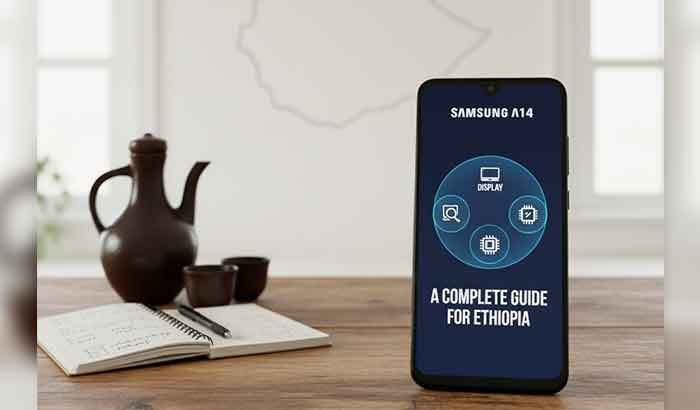
Introduction
Imagine being in Addis Ababa, browsing through phones at a local shop and spotting the Samsung A14. It’s affordable, it looks sleek, but you wonder: “What exactly am I getting for this price?” Is the display good enough? Does the RAM and storage (“room”) really let you run apps smoothly for a couple of years? And what about the chipset — will this phone hold up in Ethiopia’s network and usage conditions?
In this article I’ll walk you through the three key concerns many Ethiopian buyers have when considering the Samsung A14: RAM & Room, Display, and Chipset. We’ll cut through the specs, real-world experiences, and local context so you can decide confidently.
Quick Takeaways
- Key Fact 1: The Samsung A14 gives you a decent entry-level package — especially good battery, solid main camera and 6.6″ Full HD display.
- Key Fact 2: For many everyday users in Ethiopia (social apps, streaming, photos) the RAM/storage and chipset are adequate — but if you’re a heavy gamer or power-user, there are compromises.
- Key Fact 3: Make sure you pick the variant aligned with your needs (4G vs 5G) and check if the local model supports the networks and is optimally priced (ETB ~15,000+ at time of writing).
Table of Contents
1. Understanding “RAM & Room” in the Samsung A14
What we mean by RAM & Room
- “RAM” = Random Access Memory (how many GB your phone uses to run apps smoothly).
- “Room” = Storage or internal memory (how much space you have for apps, photos, videos).
Together, RAM & Room determine how comfortable the phone feels after you use it for months.
What the specs say
- The Samsung A14 is available in configurations like 4 GB RAM + 64 GB storage, 4 GB RAM + 128 GB storage, sometimes 6 GB RAM + 128 GB storage.
- Storage is expandable via microSD in many models.
- On Ethiopian online listings: 64 GB/4 GB versions show up at around ETB 15,000–16,000.
What this means for Ethiopian users
- If you mostly use social media (WhatsApp, Telegram, Facebook), stream videos, take photos — the 4 GB RAM + 64 GB storage version can work.
- However: With time, apps get heavier, updates accumulate, background services multiply. You may notice slower switching between apps, or less “smoothness”. Indeed one reviewer notes: “The opening, closing and scrolling animations are mostly laggy … the phone is not for the younger generation who are quick with their phones.”
- For better future-proofing, picking the 6 GB+ version (if available) or storage higher than 128 GB helps — especially if you save many photos/videos or install many apps.
- Local market tip: Because the price difference may be moderate, consider investing slightly more for the version with more “room” to avoid early frustrations.
Local Ethiopian Market Context
- Many phones for ETB 15,000–17,000 range trade-off major flagship specs. In that context, the A14 is competitive because it comes from a trusted brand (Samsung) and has enough baseline specs.
- Make sure the version you buy is brand new, not a used import, check warranty and network compatibility (see Chipset section).
- Storage matters in Ethiopia: many users store lots of offline videos/music due to inconsistent connectivity, so the “room” part has real importance.
2. Display of the Samsung A14
The headline specs
- The Samsung A14 has a 6.6-inch Full HD+ (1080 × 2408) PLS LCD display.
- In some 5G variants the refresh rate is up to 90 Hz, improving smoothness.
- According to the official Samsung site: “6.6″ gives you plenty of space to fill with your favourite movies, games and memories.”
How it performs in real life
- Reviewers say that while the panel is “good for the price”, it does have its limitations: “Not the brightest or most contrasty display around.”
- In bright daylight (Ethiopia’s sunlight), budget LCDs can appear less vibrant than AMOLED or higher-tier displays.
- For everyday tasks like browsing, streaming YouTube, reading, the display is more than acceptable.
Key things to check when you purchase locally
- Make sure the screen is indeed 6.6″ FHD+ and not a lower resolution variant — some regional or older models might differ.
- Test it in the store: view it under sunlight, check for brightness, reflection, and viewing angles.
- Ask about refresh rate: If it’s the 90 Hz variant (in 5G version), you’ll get smoother scrolling — a nice bonus.
- Consider protective items: since it’s a larger screen size, a good protective case and screen protector help with durability.
Local User Experience & Relevance
- For the Ethiopian market, where many users watch videos offline or use streaming apps in varied lighting, having a decent display is important. The A14’s display strikes a good balance for the budget.
- Many users will not care about ultra-smooth 120 Hz or OLED — the fact that it offers Full HD and a large screen is a strong value.
- If you frequently watch in sunlight outdoors (e.g., commuting) then consider checking brightness levels in-store.
Read More: Samsung A15 – Complete Guide for Ethiopian Buyers
3. Chipset (Performance) of the Samsung A14
What chipset means
The chipset (also called SoC – system on chip) determines how fast the phone is, how well it handles multitasking, gaming, and future software updates.
What the specs show
- The LTE (4G) version of the Samsung A14 uses a chip such as the Helio G80 (MediaTek) or the Exynos 850 in some markets.
- The 5G variant uses stronger chips like the Exynos 1330 or the Dimensity 700.
- Reviewers describe the performance of the 4G version as “mediocre for heavy use” but acceptable for normal everyday usage.
What that means for you
- If you use your phone mainly for WhatsApp, streaming, browsing, photos — the chipset in the A14 will serve well.
- If you play heavy 3D games, expect some lag or lower graphic settings. One review: “You can’t play resource-heavy 3D games on this phone.”
- For longevity: because chipsets get taxed by newer apps and updates, the stronger the chipset, the longer your phone will feel “snappy”.
- Since network speeds and background apps are increasing in Ethiopia, consider a variant with a stronger chipset if you have slightly higher budget.
Network & Compatibility in Ethiopia
- Good news: According to compatibility check, the Samsung A14 supports relevant GSM/UMTS/LTE bands in Ethiopia’s network environment.
- While 5G is less widespread in Ethiopia currently, having a 5G-capable chipset might be less important than having good 4G support and software updates.
- Ensure the version you buy in the local market is the global model (not a jailbroken or import with limited support or warranty).
4. How to Choose the Right Variant in Ethiopia
| Factor | What to look for | Why it matters |
|---|---|---|
| RAM & Storage | At least 4 GB RAM and 64 GB storage; better if 6 GB/128 GB | Enough “room” for apps, media, and future usage |
| Display Variant | 6.6″ FHD+ panel, preferably 90 Hz if 5G | Better viewing experience and smoother feel |
| Chipset | Prefer stronger chip (Exynos 1330 / Dimensity 700) if budget allows | Better performance and future-proofing |
| Network Compatibility | Ensure supports Ethiopian LTE bands | Avoid buying a version that doesn’t fully work locally |
| Price & Warranty | Compare ETB market price (around ETB 15,000+) and verify warranty | You want value and reliable after-sales support |
Local Tip: If you find the 4GB/64GB version at ~ETB 15,000 and the 6/128 version at ~ETB 18,000–19,000, the extra investment may be worth it for a smoother experience and longer lifespan.
5. Pros & Cons — And When to Choose the Samsung A14
What the Samsung A14 does well
- Good value for budget smartphone users — strong brand backing (Samsung).
- Large 6.6″ FHD+ display — a step up over many ultra-budget phones.
- Decent main camera (50MP) and respectable battery (5,000 mAh) for everyday use.
- Encryption, expandable storage, trusted brand ecosystem in many markets.
Where there are trade-offs
- Performance whereas fine for entry tasks, may lag for heavy gaming or intensive multitasking.
- Display brightness/contrast may not match higher-tier devices, especially outdoors.
- Charger speed modest (some variants only 15 W).
- Need to double-check that you’re buying a supported variant with full warranty in Ethiopia.
When this phone is a strong match
- You are a beginner to smartphone usage or upgrading from a very basic phone.
- You do social media, take photos, stream videos, use apps daily — and want a reputable brand at budget-friendly price.
- You want trusted after-sales support in Ethiopia.
When you might delay or look elsewhere
- You frequently play high-performance games, edit videos, or demand ultra-high speed and large RAM.
- You need ultra-bright display for outdoor professional use, or super-fast charging.
- You want 5G right now and want the cutting-edge specs rather than budget value.
FAQs: (People Also Ask)
Q1: What is the difference between Samsung A14 display and other budget phones?
A1: The Samsung A14 offers a Full HD+ 6.6″ panel, which is better resolution than many ultra-budget phones that use HD or lower-res screens. It also comes from Samsung’s PLS/PLS-LCD lineage, which tends to be decent for quality.
Q2: How much RAM and storage should I get for Ethiopia?
A2: At minimum, 4 GB RAM + 64 GB storage is workable for everyday tasks. But for smoother experience and future-proofing, go for 6 GB RAM + 128 GB storage if budget allows — especially if you store lots of videos/apps.
Q3: Is the chipset in Samsung A14 good for gaming?
A3: It handles casual games and everyday apps well, but for heavy 3D games or applications demanding high performance, you may experience lag or lower setting requirements. One long-term reviewer noted this limitation.
Q4: Will the Samsung A14 work with Ethiopian mobile networks?
A4: Yes — versions of the A14 support key GSM/UMTS/LTE bands used in Ethiopia. You should still verify the specific variant’s network compatibility when purchasing.
Q5: Should I buy the 4G or 5G version of the Samsung A14 in Ethiopia?
A5: If 5G service is not strong or you prioritise cost and reliability, the 4G version is a sensible choice. If the price difference is small and you want some future-proofing, go for the 5G version with better chipset and maybe higher refresh rate display.
Conclusion
Choosing the Samsung A14 in Ethiopia is a smart, balanced move for many users. You get a trustworthy brand, a large crisp display, enough RAM & room for everyday use, and a chipset that gets the job done. It’s not ultra-flagship, but it doesn’t have to be — especially when your use case is social apps, media, photos, and general day-to-day mobility.
If I were advising you today, I’d say: go ahead and pick the highest specification variant you can afford (e.g., 6 GB/128 GB), check the local market price carefully (ETB ~15,000+ is a benchmark), verify warranty and network support, and enjoy a phone that will serve you well for the next couple of years without major compromise.
Your smartphone choice should feel confident, not full of “maybe-it-works”. And with the Samsung A14, you can step into that comfortable space.
?